Maha Budget: CM Fadnavis announces loan waiver for farmers, infrastructure projects
The loan waiver scheme will be applicable to farmers with outstanding debts of up to Rs 2 lakh and whose crop loans have arrears till September 30, 2025.
The fiscal deficit has been projected at ₹13,595.96 crore, amounting to 2.18 per cent of the estimated Gross State Domestic Product, comfortably within the 3 per cent ceiling prescribed under the Fiscal Responsibility and Budget Management framework.




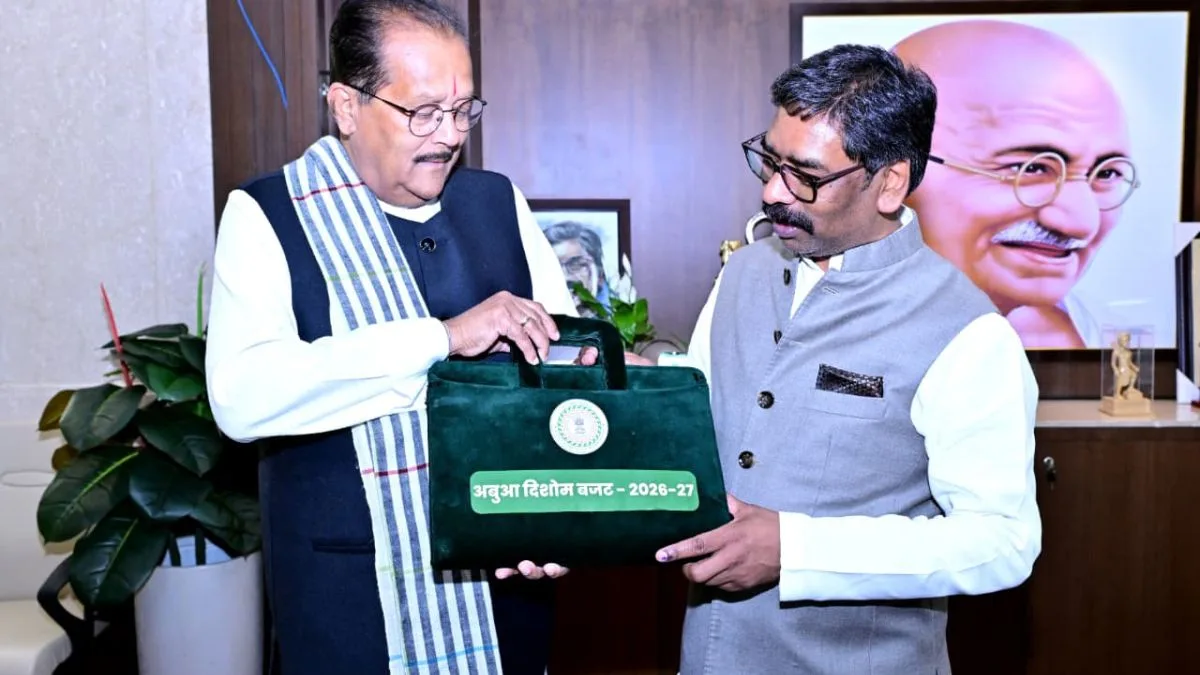
Photo: SNS
Jharkhand Finance Minister Radha Krishna Kishore on Tuesday presented the state’s Budget for 2026-27 in the Assembly, outlining a fiscal framework that favours calibrated expansion over dramatic restructuring. With a Gross Budget Estimate of ₹1,58,560 crore and a proposed expenditure of ₹1,20,851.90 crore, the blueprint signals continuity, social sector consolidation and measured capital growth.
The fiscal deficit has been projected at ₹13,595.96 crore, amounting to 2.18 per cent of the estimated Gross State Domestic Product, comfortably within the 3 per cent ceiling prescribed under the Fiscal Responsibility and Budget Management framework.
Advertisement
The state expects to mobilise ₹46,000 crore from its own tax revenues and ₹20,700 crore from non-tax sources. It anticipates ₹51,236.38 crore as its share in central taxes and ₹18,273.66 crore as central assistance, while proposing market borrowings of ₹22,049.96 crore.
Advertisement
Jharkhand’s GSDP at current prices for 2024-25 is estimated at ₹5.16 lakh crore. The government has articulated an ambition to double this figure within five years, implying a nominal growth rate of around 14 per cent annually. Whether that target can be realised will depend less on projections and more on investment conversion and administrative delivery.
The proposed capital outlay of ₹37,708.10 crore marks an 8.5 per cent increase over the previous year. While this reflects sustained infrastructure spending, revenue expenditure continues to command the larger share, underscoring the state’s enduring welfare commitments.
The social sector receives ₹67,459.54 crore, the largest allocation among sectoral heads. A Child Budget covering 138 schemes has earmarked ₹10,793.16 crore, representing 10.7 per cent of the total plan size. A Gender Budget spanning 232 schemes across 17 departments accounts for ₹34,211.27 crore.
Healthcare expansion plans include PET and CT scan facilities in all five government medical colleges, mammography units in 24 district hospitals, cath labs in medical institutions, and 750 ‘Abua’ medicine centres aimed at ensuring affordable drug access.
Agriculture and rural development remain central to the fiscal narrative. Allocations include ₹25 crore for the Women Farmers Prosperity Scheme and ₹19.88 crore for the expansion of cash crops, including jute.
The budget provides ₹162.20 crore for cooperative marketing complexes equipped with solar powered cold storage in Assembly constituencies. Rural connectivity has been strengthened with ₹1,000 crore under the Chief Minister Gram Sadak Yojana and ₹730 crore for bridge construction through the Gram Setu Yojana.
On the industrial front, the state expects investments worth ₹20,000 crore under various policies in 2026–27, with potential employment generation of around 15,000. Investment proposals reportedly secured at global forums amount to ₹1,24,230 crore, with projected employment for approximately 45,000 people across key sectors. The transition from memorandum to machinery, however, will determine whether these figures translate into sustained economic momentum.
In higher education and skill development, the government proposes upgrading 17 government polytechnics and six new institutions under the J PRAGATI scheme, launching Artificial Intelligence training in selected technical institutes, and establishing a Dr B R Ambedkar University in Chatra. Tourism infrastructure projects, including glass bridges, ropeways and eco-tourism circuits, also feature prominently.
The budget does not attempt a structural break from the past. It neither introduces sweeping tax reforms nor embarks upon radical fiscal experimentation. Instead, as presented by the Finance Minister, it consolidates a governance approach that blends social spending with incremental infrastructure expansion while maintaining fiscal discipline.
For a mineral rich state vulnerable to commodity cycles and revenue fluctuations, caution may be a strategic choice. Yet ambition, especially the goal of doubling GSDP within five years, will demand more than fiscal prudence. It will require institutional efficiency, credible industrial follow through and consistent execution on the ground.
In that sense, the 2026-27 Budget is less a proclamation of transformation and more a reaffirmation of intent. Its success will be measured not by its aggregate size, but by the extent to which its numbers move beyond the page and reshape Jharkhand’s economic landscape in tangible ways.
Advertisement